
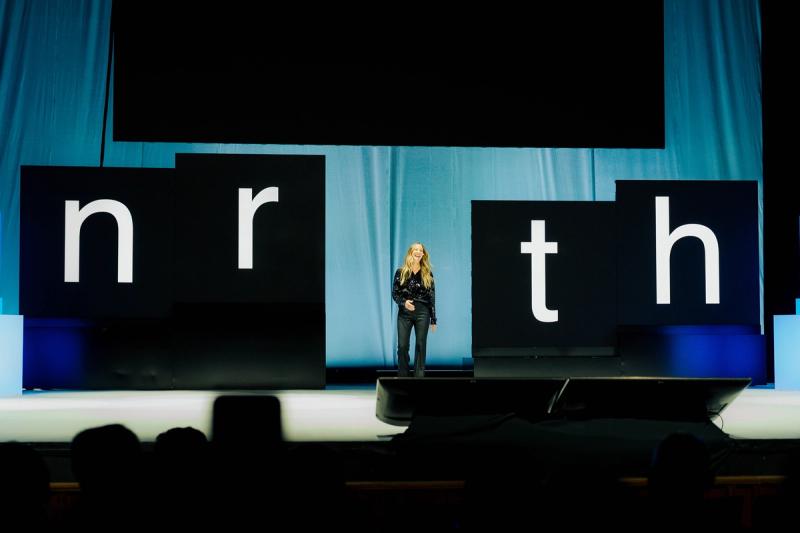
A new strain of Canadian confidence took over downtown Toronto this week, as thousands of entrepreneurs, investors, executives and wonks convened for Nrth Festival, the recently rebranded tech event formerly known as Elevate. For two and a half days, delegates wearing lanyards and toting half-open laptops and food-truck lattes scurried along Front Street to catch keynotes, bounce ideas and – judging by the volume of startup pitches overheard in the lobby – shoot their shots.
And why not?
The inherent optimism of the tech set is colliding with an undeniable “the times they are a-changin’” vibe, born of a unique slate of macroeconomic developments: intensifying trade instability with the U.S., burgeoning cosiness with the E.U. and surging attention from global investors. A spirit of constructive creativity was bound to take hold.
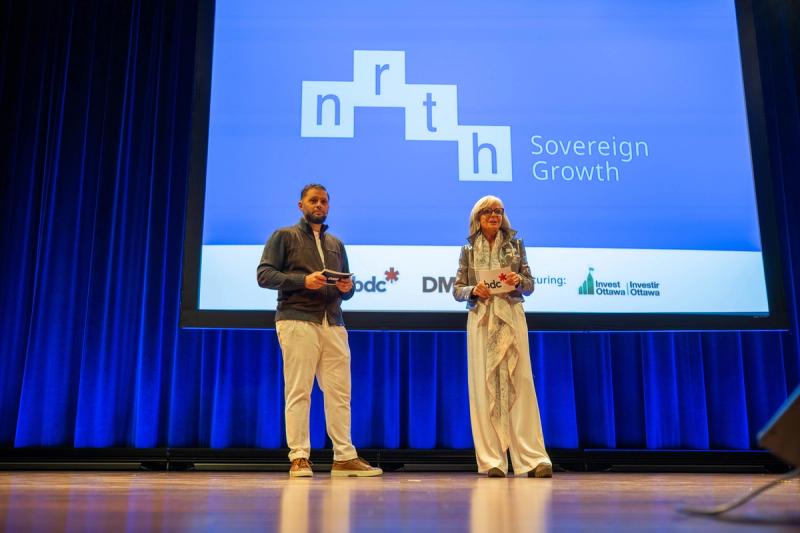
“This event is about ambition, and that’s really what we need right now,” said Isabelle Hudon, president and CEO of the Business Development Bank of Canada, during an address Wednesday morning. “[It’s] about the commitment and the belief that we can be, and that we should be, bold to reach new heights.” Or, as Vass Bednar, managing director of the Canadian Shield Institute, put it, “I think we should bask in the glow of being the sexy underdogs of the world right now and push harder.”
Nrth offered no shortage of examples – some conceptual, many being validated and adopted at a rapid clip – of how Canadian innovators are rallying to that. Here are the ones we’re keeping an eye on.
Get our weekly newsletter—the people, places, and ideas revealing where Canada is headed.
1. Sovereign space capacity
For decades, Canada has been a clutch supporting player in space initiatives led by other countries, from sending up some of the world’s first satellites to developing the Canadarm to training world-class astronauts, including Joshua Kutryk, who is scheduled to fly to the International Space Station in early October. But several recent developments at the federal level – inspired partly by geopolitical dynamics, partly by technological advancements and notably by estimates that the aerospace industry is now supporting 20 per cent of Canadian GDP – are making the once pie-in-the-sky notion of sovereign space capabilities a lot closer to reality. This year alone, the Government of Canada has committed $200 million toward the creation of a space-launch pad near Canso, N.S., released a new Defence Industrial Strategy with space front and centre and initiated the Launch the North program, which aims to encourage the development of Canadian light-lift rockets to launch from Canadian soil by 2028.
“That essentially enabled us,” said Hugh Kolias, CEO and co-founder of Canada Rocket Company, a Toronto-based aerospace startup developing sovereign launch capabilities for Canada, of the shift in signals coming from Ottawa. Since incorporating in November 2025, his company has raised more than $22 million in funding, secured a spot in the first phase of the Launch the North program and hired more than 30 people, including Canadians who’d been working on launches abroad and foreign nationals attracted by the mission. “We’re reversing that brain drain,” Kolias said. “It’s all of this environment that allows ambition to exist and, if anything, continues to push us to go bigger and move faster.”
Rahul Goel, founder and CEO of Markham, Ont.-based NordSpace, which develops orbital-class launch vehicles, manufactures satellites and offers launching services, said Canada has the talent, institutional knowledge and IP to meet the moment. “The government is very keen to push things, invest and move as quickly as possible and build out these capabilities,” Goel said. “It’s ultimately up to us and the ecosystem to drive that forward.”
In a shifting world order, developing sovereign space capabilities – including launches from Canadian soil – is more pragmatism than moonshot, in the view of Bachar Elzein, CEO and chief technology officer at Reaction Dynamics. His Montreal-based company develops patented hybrid propulsion rocket technology and, along with NordSpace, is a participant in Launch the North. “It doesn’t [do] us any good to shift our dependency from one allied country to another,” said Elzein. “Sovereignty means being masters of our own destiny.”
It’s a style of patriotism that was pervasive at the gathering. On its closing day, Eliot Pence, CEO of the defence firm Dominion Dynamics, left his panel audience with instructions that reflected a similar sentiment: “Act with the same level of urgency and patience and ambition that the prime minister has set out. I think [Carney] is an N-of-1 leader globally...and we should execute as quickly as he wants us to."
2. Cleaner critical minerals
Canada’s critical minerals are having a moment. They featured heavily in both the Canada Investment Summit and Prime Minister Mark Carney’s global appearances afterward. As countries scramble to build data centres, electric vehicles, solar panels and smartphones, the world really does need minerals like copper, silica, cobalt and nickel – or, as Carney loves to call them, “what Canada has to offer.”
But according to two speakers at Nrth, there’s an additional opportunity for Canada in this gold rush: more sustainable extraction of valuable materials.
“There is a slight irony in the use case for some of these critical minerals and materials – particularly around the clean energy transition. That’s because upstream mining is incredibly dirty, in most cases,” entrepreneur Douglas Pimlott told attendees during a panel discussion on Wednesday afternoon. “You generate enormous quantities of tailings. There’s contamination, and it’s energy- and emission-intensive. And if the point of extraction isn’t clean, then we just export those environmental costs somewhere else.”
Pimlott and his team at Carbonyx, the Vancouver-headquartered cleantech startup where he serves as co-founder and CEO, are working to address the issue by mining not at the ore face, but rather in the tailings and industrial waste that companies produce. One of their recent developments is an electrochemical mineralization process that recovers valuable materials from waste rock and concrete while also, conveniently, removing carbon from the atmosphere.
In Thorold, Ont., another upstart is advancing cleaner critical-mineral extraction: Destiny Copper, which has developed a patented chemistry-based system that separates copper – for which global demand is increasingly outpacing supply – from industrial and mining waste streams. “It’s extraction using a new method to add to that supply chain,” said Greg Hanna, the company’s founder and CEO. The process lessens the footprint of production and also draws extra value out of materials that would otherwise go to waste. “We wanted to do something that was greener, but we also wanted it to be viable from a business point of view,” Hanna explained. “It takes a lot to produce the world we live in, so we can’t take it for granted. We need to be cautious and recycle what we’ve got.”
3. Personalized cancer vaccines
Given 42 per cent of Canadians are projected to receive a cancer diagnosis in their lifetimes, it isn’t hyperbole to say that the disease affects everyone, directly or indirectly. Not surprisingly, many Canadians are developing novel ways to prevent, treat and cure the disease.
Among them is Brad Sorenson, a veteran biotech executive who is now president and CEO of Providence Therapeutics, a Calgary-based clinical-stage biotech company developing mRNA-based immunotherapeutics meant to provide individualized treatments for cancer and hard-to-treat infectious diseases. As he shared with delegates during a keynote, the genesis for Providence came when Sorenson’s son Adam, then 13, received a terminal diagnosis of the brain cancer glioblastoma multiforme.
A doctor in Calgary was able to get Adam into remission but recurrence was likely. Feeling a deep need to do something, Sorenson raised some money and reached out to Eric Marcusson, a “brilliant scientist” who became Providence’s co-founder. “I said to him, ‘If I could do anything in the world to tackle this disease, what would you suggest I do?’” Sorenson recalled. “He said, ‘mRNA.’”
The fledgling team began work on an mRNA cancer vaccine and, by early 2020, was ready to enter clinical trials. The pandemic forced a pivot: Providence developed a made-in-Canada mRNA COVID-19 vaccine, which provided, in Sorenson’s words, “a significant validation of the company and our ability to deliver at a pretty high level.”
When Adam’s cancer came back in 2023, this time spreading through the spine, the Providence team rushed to develop a personalized vaccine. Within six months, said Sorenson, the cancer was effectively gone.
Since then, Providence has treated 30 patients on compassionate bases in single-subject clinical trials, with results showing superior tumour control. “We’ve treated triple-negative breast cancer, ovarian cancer, bowel cancer, bone cancer and cancers of the head, neck and brain,” Sorenson said. “We’ve treated pediatrics, and we’ve treated adults.” The company currently offers both an off-the-shelf vaccine for screened patients who qualify for it and personalized custom vaccine development, based on individual tumours and mutations. It’s cutting-edge, and Sorenson is proud to be pioneering it in Canada, though he wishes the country’s regulatory structure made it easier to offer seriously ill patients access to new treatments, such as the “right-to-try” laws in place in other countries.
“Everybody listening knows somebody who’s had cancer and knows that the treatment is almost as bad as the disease,” he said. “If you’re able to change that paradigm, people are just urgently wanting that.”
4. Indigenous accelerators
Indigenous entrepreneurs comprise one of the most dynamic segments of Canada’s startup scene. Métis, First Nations and Inuit individuals are now five times more likely than their non-Indigenous peers to start a business, especially if they’re young, and their ventures contribute tens of billions of dollars to the country’s GDP.
Yet for all this, Indigenous entrepreneurs struggle to access capital, connections and mentorships to grow their businesses. Bobbie Racette experienced it herself while launching Virtual Gurus, the Calgary-based virtual-assistant startup she scaled to millions of dollars in recurring revenue and exited after a sale to U.S.-based Zirtual in late 2025. As a queer Métis-Cree woman, she got used to navigating a system not built to support her: during the company’s seed round, she received 170 no’s before securing a single investor. “People didn’t believe in me,” she said during a panel late Thursday morning.
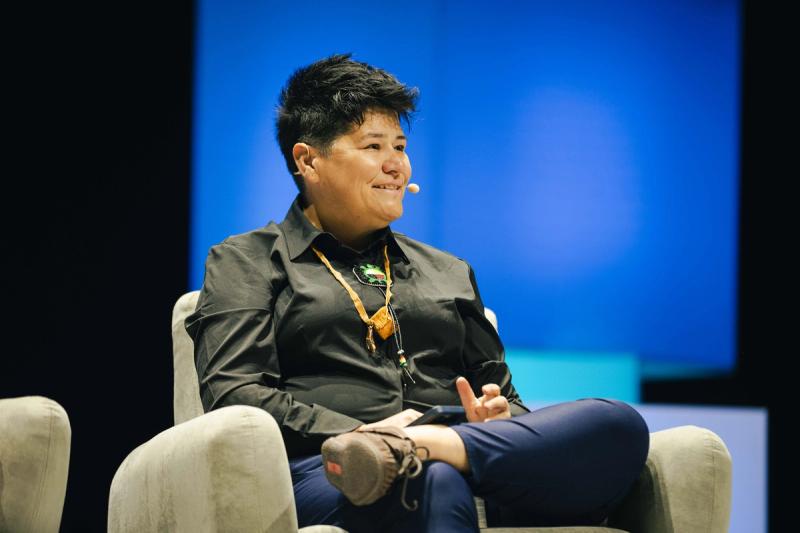
But the groundswell of Indigenous founders “who are killing it” and the emergence of material supports to accelerate their work have Racette seeing a brighter future. There’s the upcoming opening of the City of Toronto’s Indigenous Centre for Innovation and Entrepreneurship, a new incubator that will offer business programming, advisory services, mentorship and shared workspaces. There’s the growth of the Indigenous Tech Circle, a community of Indigenous tech founders and professionals that now includes more than 3,000 members, according to Racette. And there’s Racette’s new venture, Tapwi – that’s “truth” in Cree – an “AI co-founder” meant to give underrepresented entrepreneurs access to resources and tools that meet their needs. In time, Racette plans for Tapwi to include a venture arm, as well as services to help founders buy and grow existing businesses.
“We need to learn how to pitch to people that are not like us,” Racette explained. “We need to learn how to deal with money traumas and have people that are non-Indigenous come and support that. That’s reconciliation to me. That’s what we need.”
5. Circular clothing chains
Canada, like many advanced economies, has a clothing problem. We buy a lot of new apparel, most of which is imported, and much of what we buy ends up in the trash: about 12 kilograms per person every year. This waste stems partially from human laziness, partially from disconnected supply chains and largely from the fact that the textiles used in modern clothing manufacturing are full of things that are hard to recycle, such as elastane and dyes.
“As an industrialized society, we have got very sophisticated at making materials, but unfortunately, we are colossally unsophisticated in un-making them,” said Terri Riedle during a talk on Thursday afternoon. Reidle is the Halifax-based head of Partnerships, North America, for Samsara Eco, an Australian company that has partnered with two Canadian companies to develop a better unmaking process.
Samsara Eco is in the business of enzymatic recycling, using specialized enzymes to break plastics and textiles down into their original building blocks, known as monomers, so they can be turned into new items. It recently completed a trial with athleisure giant Lululemon and Debrand Services, a B.C. company that handles reverse logistics for apparel and footwear. Debrand collected more than 20,000 kilograms of damaged and returned Lululemon garments in its Surrey facility, sorted each, removed what’s known as irritants – that’s zippers, buttons and other non-textile elements – shredded the garments and shipped them off to Samsara Eco, which broke it all down into tiny polymer chips that were spun into yarn, which eventually became the limited-edition Lululemon Packable Anorak jacket. “This was the very first time a 100 per cent recycled polyester capsule collection was available for retail sale,” Riedle said. “We need to change from a ‘take it, make it, use it, waste it’ linear model to a ‘take it, make it, use it, collect it, make it again, use it again, take it again, make it again’ model. That is true circularity.”
Amelia Eleiter, Debrand’s CEO and co-founder, said that advancements in AI and automation now make it possible to scale pilots such as these. All that’s needed is investment and a willingness of all the players in the apparel supply chain to think a little differently. “The new transformation that we’re speaking about, this new economy, is not going to be the same as it was in the past,” Eleiter said. “Scale doesn’t have to necessarily be about more volume and more product. It definitely needs to be about more value and more revenue, but it can be about more depth.”