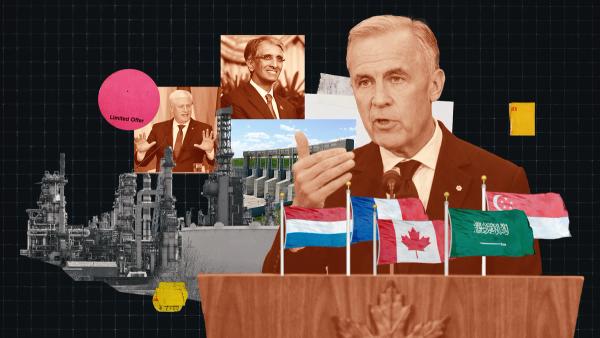
A parade of some of the world’s biggest business names – from bankers to pension funds, venture capital companies to energy behemoths – took the stage at this week’s Canada Investment Summit in an effort to jumpstart billions in new investments.
In the crowd, investors from more than 30 countries and representing more than $120 trillion in assets heard a range of arguments about why Canada, and why now: in the words of one investment banker, it was the beginning of an era of “Canada unleashed.”
Themes of trust, talent and access to resources wove through a day that began with Prime Minister Mark Carney telling the crowd that Canada is “building, trading and investing with an ambition and speed not seen in generations.”
On the stage, in bilateral meetings and breakout rooms, about 300 attendees at the invitation-only event traded ideas on the opportunity ahead. Here are eight of the ideas that won the day:
1. A mega tax break
The first idea to boost investment unveiled at the summit was one that the money managers in the crowd were sure to like – tax savings.
Prime Minister Mark Carney announced a new “Productivity Mega Deduction” that will allow businesses to immediately deduct 100 per cent of the cost of new investments in machinery, equipment and technology.
“We call it the productivity mega deduction in part because we used super deduction in the last budget,” Carney joked. “But we also call it the mega deduction because the advantage it confers is huge.”
The new rules will increase the amount of assets eligible for immediate expensing from roughly 15 per cent to 65 per cent, and include fibre-optic cable, mining property, pipelines, software, R&D, computers, aircraft and vehicles, patents, rail track, bridges and roads. The move will reduce the marginal effective tax rate on new business investment from 13 per cent to 6.4 per cent, making Canada “by far the most tax-competitive advanced economy for new investment,” Carney said. The rate will be less than half that of the U.S. and one-quarter of the the G7 average.
For years, economists and business groups have called for a more competitive tax regime to spur investment in Canada. A report last month from TD predicted that Canada could enter a new “investment supercycle,” boosting standards of living by up to $12,000 a year, if the government acts to improve tax competitiveness and speed project approvals.
There’s likely to be political pushback, but with a trade war raging it may well be smaller than it otherwise would be. New Democrats typically push for higher corporate taxes, but B.C. Premier David Eby told Be Giant, “This the world that we’re in right now in terms of the impact of the Trump tariffs on British Columbia, on our softwood sector in particular. Taking the steps necessary to ensure that we're competitive around international investment, getting our projects moving, is really important to us.”
2. Digging deep
From Ontario’s Ring of Fire to British Columbia’s Golden Triangle, Canada produces 60 different minerals and metals. There are the ones we all know – copper, zinc, gold – but there’s also antimony, neodymium and germanium – critical minerals key to building data centres, EVs, ammunition and more of what the economy of the future will need.
The investment summit’s official prospectus included 63 mining and minerals projects, roughly double the number of any other sector. They ranged from a $170-million neodymium-iron-boron magnet manufacturing project in Saskatchewan to Alberta’s $2.47-billion Clearwater Project to produce lithium from brines in the Leduc reservoir.
Canadians may be digging deeper, but capital costs are steeper, and executives at the summit stressed the need for investment in roads, rail, bridges and other infrastructure.
Jonathan Price, the president and CEO of Teck Resources, said copper demand will double in the next decade, leaving the world with a supply shortfall of about 30 per cent. “That is a significant gap that needs to be closed, and it indicates that we need to deliver more mines, more quickly,” he said. It would take 60 more mines the size of Teck’s giant Highland Valley facility – Canada’s biggest – just to fill the gap. “We have to invest hard just to stand still,” he added.
Tim Gitzel, president and CEO of Cameco, touted Canada’s reputation as a stable, reliable jurisdiction as a key advantage in the industry. Canada is the world’s second largest uranium producer, trailing only Kazakhstan – which is tucked between Russia and China, he said, making it “a difficult neighbourhood to live in.”
3. Flight plan
It’s been a long time coming, and it’s bound to face stiff political headwinds, but Canada is finally taking steps to privatize airports.
Carney told the summit he would seek “private investment through long-term concessions to operate Canada’s four largest airports” – in Toronto, Montreal, Vancouver and Calgary – including international investors.
The government would still own “underlying land and assets, but we will unlock their true value, by bringing in new capital and expertise into their operations and growth,” he said. The “billions of dollars” in revenue from privatization would then be invested in regional airports and other transportation projects, as well as in “a sovereign broadband backbone” to connect more Canadians. Some of the money could also be used to build direct data links to Europe and Asia.
A grand plan to use existing transportation infrastructure to build more and different infrastructure sounds good, but not everyone is going to like it. Unifor president Lana Payne, normally a political ally of the prime minister, warned of “outsourcing and contract flipping” that would threaten wages. NDP Leader Avi Lewis called it a mistake.
In a fireside chat with Public Sector Pension CEO Deborah Orida, Carney pointed out that private investment in major airports is hardly unusual. PSP is invested in seven airports worldwide, including in Greece, the U.K. and Germany. Canada will be able to learn from other countries’ experiences: “We’re getting the benefit of being late to this, if you will, because we’ve seen transactions that don’t work well, that don’t take all those stakeholders into account, and others that do.”
4. Getting Canadians to invest in Canada
It was a theme that came up again and again throughout the summit – international fund managers are underinvested in Canada and need to be convinced to do more. Maybe it will help that Canadian CEOs decided to lead by example.
The run-up to the conference saw a flood of new investment announcements by banks and pension funds. RBC was first out of the gate last week with a $1.4- billion fund to invest in Canadian tech firms with the “potential to scale into global powerhouses.” Too many startups in Canada see U.S. money step in when it’s time to scale up, RBC CEO Dave McKay told the conference, and too much talent and intellectual property winds up leaving the country. The new fund, he said, is meant to “help mind and management stay here and scale here.”
RBC’s move was just the start of a stampede. BMO announced it would commit up to $70 billion in capital to critical sectors including AI, defence and electrical infrastructure. CIBC said it would deploy $2 billion to finance small and medium-sized Canadian defence companies and TD CEO Raymond Chun opened the Milken Institute conference earlier in the week with a promise to commit $150 billion over five years to help spark an investment “supercycle.”
The pension funds jumped in as well – $10 billion in new money from the Ontario Teachers Pension Plan, a pledge by the Public Sector Pension Investment Board to get its Canadian portfolio above the $100-billion mark within a few years, and the launch of a $50-billion “Maple Fund” by the Canada Pension Plan Investment Board, in co-operation with Mark Carney’s old firm, Brookfield Asset Management, to invest in infrastructure and strategic industries.
It was certainly fortuitous timing, or maybe the result of a little arm twisting by the prime minister, who has been pressuring Canadian CEOs to be more aggressive and ambitious. In any case, it may help forestall any need for the government to force pension funds to expand their Canadian holdings, something some experts have suggested. “We want to create the conditions where those institutions, who are very expert, very strong, world-renowned, want to invest and compete with each other to invest in Canada,” Carney said.
Get our weekly newsletter – the people, places, and ideas revealing where Canada is headed.
5. Hurrying hard on project approval
Mindful of the regulatory hoops and overlapping jurisdictions that have plagued investment in this country for years – a reputation it has not yet fully shed – the prime minister offered a pledge to counter the “time kills all deals” truism: “For projects and supply chains, our standard will be simple,” he said. “One project. One review. One year.”
The accelerated timeline was first proposed in May, but the summit was its coming-out party. “Investors should know that when Canada says it wants something built, Canada will get it built,” Carney said.
In an interview with Be Giant, Manitoba Premier Wab Kinew sounded a note of caution. “I do think that there's clearly been a message from investors and business people, and just the average Canadian who wants to see a project that they think is going to be good for their jobs or their job prospects to move forward in the future,” he said. “[But] I think one of the challenges of this era will be to figure out how we make sure that we don't resolve into a vetocracy, and instead are carefully listening and hearing valid concerns while also having the speed that's required to respond to how things work today in an era dominated by Donald Trump.”
At the Milken Institute’s Global Dialogues conference that preceded the investment summit, analysts noted the need for a second tier of fast-tracked project approvals. Jeremy Carter, the global analytical head of Fitch Ratings, one of the world’s leading credit rating agencies, said Canada’s Major Projects Office sends the right message, but he worried that a focus on “some very high-level marquee projects” might be thought sufficient. “What is needed here are thousands of projects.”
John McKenzie, the CEO of TMX Group, which operates Canada’s major stock exchanges, echoed the idea. “I would love there to be a minor projects office beside the major projects office,” he said.
Carter bluntly characterized the Canadian problem. “The difficulty in building stuff in Canada” is the challenge, he said, “rather than the absence of capital. … There’s plenty of money.”
But McKenzie said speeding regulatory proposals means Canada has stopped “putting the puck in our own net.”
Jon Gray, the president and chief operating officer of New York-based Blackstone Group, told the summit he believed he was seeing an era of “Canada unleashed.”
Regulatory speed bumps are not uniquely Canadian, he said, but he’s certainly familiar with them. It once took Blackstone 16 years to build a power transmission line from Quebec to New York City, he said.
6. Making new friends in Europe
The first stop for the prime minister after the summit was Strasbourg, France, where European Commission President Ursula von der Leyen’s state of the union address included opening a door for Canada to become the European Union's first "associate member."
“We want to bring the relationship with Canada to the highest level possible,” she said. “We must urgently reimagine our partnerships. So I would like to work with you on opening the door for Canada to be the first associate member of the EU.”
It was a reflection of a theme repeated throughout the summit.
“Conversation turns to commitment. Commitment turns to investment,” Carney said at the summit only the day before. “I'll give an example. Last August, Minister [Tim] Hodgson and I sat down in Berlin with one of Germany's largest energy companies to talk about Canadian [liquid natural gas]. To be clear, that's August, 13 months ago. Nine months later, they signed a 20-year agreement to buy two million tonnes a year from the Ksi Lisims LNG project on our West Coast.”
At the Milken Institute’s conference before the summit, Fitch Ratings’s Carter argued that there is no real alternative to engaging with a “vibrant” U.S. economy. Diversification is a laudable goal, he said, but cozying up to Europe isn’t going to cut it.
“Canada has low productivity, Canada is not in innovative sectors,” he said. “Canada has the same problems the European Union has.”
Summit speakers disagreed: Canadian natural resources and shared values make Canada a key market for Europe, Deutsche Bank CEO Christian Sewing told the crowd. “It's about values and value. So you play both sides, and that is something which is close to our heart.”
Results may not be swift. It is notoriously difficult to get consensus from the 27-member trade bloc; 10 members have yet to ratify a trade deal negotiated in 2017 and there were quick rumblings of discontent from EU member states about the lack of consultation on the associate member idea. But regardless, there are opportunities to work more closely on, for instance, energy exports and data co-operation.
"One thing that really makes sense is for Canada to host data centres and storage for Europeans with our much cheaper electricity,” says Heather Exner-Pirot, director of energy, natural resources and environment at the Macdonald-Laurier Institute. “It’s a lot more efficient to export compute than LNG."
With new digital connections directly to Europe and massive new hydro developments in the works for Labrador, the math could look interesting.
7. Canada’s multi-pronged labour advantage
Canada has some distinct advantages in attracting, educating and retaining a skilled workforce.
According to Staircase Ventures CEO Janet Bannister, the quality of Canadian workers and the global perspective many bring are helping to attract capital.
“Toronto is the third largest tech hub in North America and the fastest growing [one]. The number of tech workers in Canada has grown three times as quickly as the U.S., since 2022,” she said. “And if you look at what is driving the quality of talent, it’s two factors. It's both the homegrown and the immigrant.”
About half the population of the GTA was born outside Canada, which Bannister says gives Canada a distinct advantage. “That, combined with our proximity to the U.S., and the relatively small size of the Canadian market, means our companies are thinking globally from day one,” she said.
Jordan Jacobs, co-founder and managing partner of Radical Ventures, agreed: “If you want to commercialize internationally, you can pick people from the local population who are actually from places around the world, can speak the language, know the customs and can basically be an international sales workforce from your home base.”
Two prominent examples of that international brain gain are the Canadian researchers Yoshua Bengio and Geoffrey Hinton, the “godfathers of AI.” The Moroccan-born Bengio emigrated as a child and teaches at the Université de Montréal, while the British-born Hinton is professor emeritus at the University of Toronto.
According to the University of Toronto’s Rotman School of Management professor Ajay Agrawal, thousands of students have trained under them over the past 15 years, giving Canada a distinct advantage.
“When you’re hearing people here talking about talent and you’re thinking, ‘Well there’s talent in all advanced countries,’ it's disproportionately in Canada because of the pioneering work done here,” he told the summit. “There’s about an eight-year advantage, so that's why talent is so dense.”
The depth of talent isn't limited to AI and the tech sector. According to Statistics Canada, in 2025 nearly two-thirds of Canadians aged 25-64 had college or university credentials, the highest in the G7 and far outpacing the OECD average of 41 per cent. Of those, 25 per cent of Canadian workers aged 25-64 have college credentials; the OECD average is seven per cent.
Increasing the skilled labour pool is essential for advanced manufacturing, said Bombardier CEO Eric Martel.
“We have great engineering schools, we’ve always been able to find the talent, but at the blue collar level – the people building the planes, flying the planes – we need to make sure these schools are there,” he said. “As we grow as a country, our capability to do more and seize the opportunity that is ahead of us … human capital in our industry is the most important thing.”
8. The case for Canadian defence
Unstable geopolitical times mean unprecedented demand for the Canadian defence industry, the summit heard. The increase in defence spending is not limited to Canada, which plans to spend five per cent of GDP on defence. It is happening throughout NATO.
This is a unique moment, said Matthew Bromberg, president and CEO of Montreal-based CAE. “This is beyond a once-in-a-generation increase in defence spending in NATO countries.”
He said NATO defence spending will rise from $1.5 trillion to $3 trillion over the next decade, training and arming eight million uniformed men and women during that time, up from today’s level of six million. More men and women will be recruited, trained and equipped in the next decade than over the past 50 years.
Bombardier’s Martel said the number of countries that can design, manufacture and certify a plane can be counted on a few fingers. Canada is one of them. “It's a real asset that we have,” he said. “And clearly the opportunity is outstanding.”
The Canadian defence industry is worth more than $17 billion, and Canada is the only non-European nation invited to participate in the Security Action for Europe (SAFE) program, allowing it to bid on European defence contracts.
Bromberg used a word to discuss the Canadian industry which was said time and time again at the summit: trust. “A lot of NATO countries are nervous about where they buy their equipment and whether they can sustain it and how they train on it,” he said. “And that's why they're going to come to Canada, and will continue to come to Canada.”
“High-end defence platforms operate undersea, on the surface, on land, in the air, in space and in cyberspace. And very few countries have the capability to procure, develop, train and integrate those platforms. We do.”
With files from Lisa Hrabluk

![“I get an inbound [email] every day asking can you get me into this meeting or that, and I’m just a small fry,” Frank McKenna says of the summit.](https://cdn.sanity.io/images/l3tzmu37/production/7faa2d5cc965d0933bd7c5a13e6fc6096ebca145-2880x1918.jpg?auto=format&fit=max&q=75&w=600)